- Goal Run more efficiently
- Effort Easy · Easy conversational effort
- Ground Paved path
- Felt Fresh
- Shoes Everyday trainer, about six months old
This side view clearly shows your step rhythm and landing position. It cannot show force, rotation, or which leg is which.
Test a landing a little closer to your hips.
Think this“Quick, quiet steps.”
Your step timing stays steady from one stride to the next.
Why it fits your goal
You want the same easy pace to feel smoother. Landing nearer your hips may reduce how far your foot reaches forward. The retest will show whether that helps without making the effort feel harder.
Why this was chosen first
Across several strides, your foot lands ahead of your hip while your lower leg reaches forward. A slightly quicker rhythm may shorten that reach, so this is a simple change to test first.
Watch the pattern.
Compare the landing foot with the vertical hip reference. The line appears only because this report measured landing position. Highlighted frames are the moments this recommendation uses.
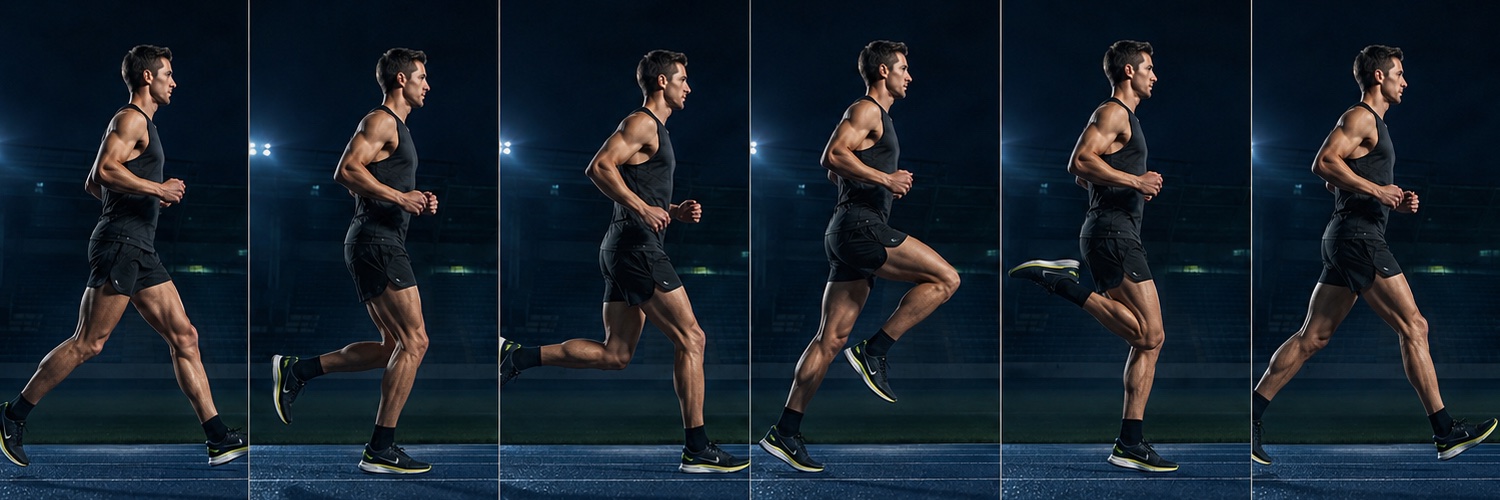 Landing · priority frame
Landing 1
Where the foot meets the ground relative to your hip.
- Time 1.85 s
- Tracking 94%
At landing, your ankle is ahead of your hip and your lower leg angles forward.
Landing farther ahead may act like a small brake. This clip cannot measure force, so use this only as a reason to test.
Backed by Foot landing positionMetronome pickups
A slightly quicker rhythm may help your feet land nearer your hips without aiming them.
- Set a metronome to match the turnover you hear in your clip. If it feels rushed, lower it until you stay relaxed.
- Run at your normal easy effort and match the beat. Keep the same speed.
- Let your feet land naturally. Do not reach or force a shorter stride.
- How often
- Twice a week
- How much
- Four blocks of thirty seconds, with a full easy minute between them
- Where
- Inside an easy run, after you are properly warm, never as the first thing you do
- Quick check
- Your steps should sound a little quicker and stay quiet. If you work harder to hold the beat, slow it down.
Stop if your breathing jumps, your steps get louder, or anything aches. Return to your normal rhythm.
See whether it helped you
What counts as a change
A result must move beyond the band beside each value. Anything inside the band is measurement noise, not progress.
If landing distance stays the same or rhythm gets less steady, stop this drill and test a different approach.
Compared with your earlier run
Your landing moved in the direction the drill aimed for and beyond the uncertainty band. Your step rate is slightly higher, and your rhythm stayed steady.
Coach detailsOpen the full evidence and measurement record
Why this priority made the cut
Picked with moderate certaintyThe coaching model's own rating of this choice. It is not a measurement, and it says nothing about how well the clip was measured.Trunk lean and how much you rise and fall were both reviewed and set aside: this clip was filmed from a propped phone, so both carry too much camera movement to act on. The difference between alternating steps was also set aside, because a single side view cannot say which leg it belongs to.
What this clip can support
Filmed on paved path. Watch for gradient. Even a gentle slope shifts trunk lean and contact time.
The biggest limitation of this clip: The phone was propped rather than mounted, so anything that depends on how much your body rises and falls carries the camera's small movements as if they were yours.
- Strides analyzed
- 7Fewer strides means any average below is a weaker description of your normal running.
- Frames sampled
- 214Positions read from the clip, one every 33 ms.
- Timing resolution
- 33 msNothing shorter than this interval is measurable, no matter how confident another number looks.
- Camera Side view, camera on your right
- Held Propped on something solid
You confirmed this angle when you filmed, and the tracked joints agree with it.
Problems worth knowing about
- The phone was propped rather than mounted, so vertical movement and trunk lean carry lower confidence than the timing values.
- The camera-side wrist left the frame repeatedly, which is why arm swing range could not be measured at all.
What this angle can show
- Step timing, rhythm, and how consistent your cycles are
- Where the foot lands relative to your hips, scaled to your own leg
- Trunk and lower-leg angles in the side plane
- How far the knee folds as the leg swings through
What it cannot show
- Which side of your body anything is happening on
- Whether your feet or knees drift inward or outward
- Which part of the foot touches down first
- Any force, load, or impact on your joints
- Anything about injury, pain, or tissue
To make the next clip stronger: Next time, stand the phone on something solid, step back until a full body length of clear ground sits either side of you, and film the same easy effort.
The numbers behind the test
Priority values come first. Each includes its quality, source, uncertainty, and limitation.
Foot landing position
ProxyHow far in front of your hip the foot lands, scaled to your own leg length so camera distance does not matter.
18.4% of leg length ahead of your hip
Plausible band: 15.8 to 21.0 % of leg length ahead of your hip. Treat anything inside that range as the same value.
What it cannot tell you: The hip stands in for your centre of mass, and a camera even slightly off square to your path stretches or shrinks this distance.
How this number was worked out
Proxy. A stand-in for something a single camera cannot measure directly. Useful for watching your own clips change over time; not a laboratory value.
Source: Measured from joint positions, scaled to your own body.
Method: Horizontal distance from the ankle landmark to the midpoint of the hip landmarks at the contact frame, divided by the hip-to-ankle length measured on the same frame.
Always true of this measurement: The hip is a stand-in for your centre of mass, and any camera angle that is not square to your path inflates or shrinks this distance.
Lower-leg angle at landing
ProxyWhether the shin is vertical, angled forward, or angled back at the moment the foot lands.
9.7° from vertical in the video frame
Plausible band: 7.5 to 11.9 ° from vertical in the video frame. Treat anything inside that range as the same value.
What it cannot tell you: Measured against the video frame, and it says nothing about which part of the foot touches down first.
How this number was worked out
Proxy. A stand-in for something a single camera cannot measure directly. Useful for watching your own clips change over time; not a laboratory value.
Source: Measured from joint positions in the image.
Method: Angle between image vertical and the knee-to-ankle line on the contact-side leg at the detected contact frame.
Always true of this measurement: Like trunk lean it is measured against the video frame rather than gravity, and it says nothing about which part of the foot lands first.
Every other value from this clip (16)
Cadence
MeasuredHow many foot contacts you make per minute across the analyzed strides.
166steps/min
Plausible band: 164 to 168 steps/min. Treat anything inside that range as the same value.
What it cannot tell you: Counted over a handful of seconds of easy running, so it describes this clip rather than your whole run.
How this number was worked out
Measured. Computed directly from evidence this clip can support at the precision shown.
Source: Counted from foot-contact events and frame timestamps.
Method: Foot-contact events are detected from the vertical and horizontal motion of the ankle landmarks, then converted to steps per minute using the sampled frame timestamps.
Always true of this measurement: It is the cadence of this clip at this pace only, not your cadence at every pace.
Stride time
MeasuredThe average time between two contacts of the same foot.
0.72s
Plausible band: 0.69 to 0.75 s. Treat anything inside that range as the same value.
What it cannot tell you: Two sampled frames of uncertainty sit inside every interval at this clip's frame rate.
How this number was worked out
Measured. Computed directly from evidence this clip can support at the precision shown.
Source: Counted from foot-contact events and frame timestamps.
Method: Mean interval between successive same-side foot-contact events across all complete cycles.
Always true of this measurement: Resolution is limited by the clip's frame rate, so short strides carry proportionally more timing error.
Strides analyzed
MeasuredHow many complete gait cycles this report is based on.
7strides
No band can be justified for this value, so read the figure as approximate rather than exact.
What it cannot tell you: Seven cycles is enough for a first read and not enough to describe a whole run.
How this number was worked out
Measured. Computed directly from evidence this clip can support at the precision shown.
Source: Counted from foot-contact events and frame timestamps.
Method: Count of complete contact-to-same-side-contact cycles that passed the visibility gate.
Always true of this measurement: Fewer strides means any average below is a weaker description of your normal running.
Ground contact time
ProxyRoughly how long each foot appears to stay down, from the frames where the foot stops moving forward.
251ms
Plausible band: 218 to 284 ms. Treat anything inside that range as the same value.
What it cannot tell you: The frames cannot see the instant the foot touches or leaves the ground, so read this as a band, not a figure.
How this number was worked out
Proxy. A stand-in for something a single camera cannot measure directly. Useful for watching your own clips change over time; not a laboratory value.
Source: Counted from foot-contact events and frame timestamps.
Method: Frames between the detected contact event and the detected toe-off event for each step, averaged. Reported only when the sampling interval is short enough to resolve it.
Always true of this measurement: Video frames cannot see the instant the foot touches or leaves the ground, so this is accurate only to about one frame in each direction.
Flight time
ProxyRoughly how long you appear to be off the ground between steps.
110ms
Plausible band: 77 to 143 ms. Treat anything inside that range as the same value.
What it cannot tell you: It inherits the same frame-level uncertainty as ground contact, and the shorter the interval the more that matters.
How this number was worked out
Proxy. A stand-in for something a single camera cannot measure directly. Useful for watching your own clips change over time; not a laboratory value.
Source: Counted from foot-contact events and frame timestamps.
Method: Interval between a detected toe-off and the next detected contact, averaged across steps.
Always true of this measurement: It inherits the same one-frame uncertainty as ground contact time, and both feet can be briefly ambiguous.
Time on the ground
ProxyThe share of each step spent in contact rather than in the air.
70% of each step
Plausible band: 64 to 76 % of each step. Treat anything inside that range as the same value.
What it cannot tell you: A ratio of two frame-limited estimates, so the band around it is wide enough to cover most of what you would call normal.
How this number was worked out
Proxy. A stand-in for something a single camera cannot measure directly. Useful for watching your own clips change over time; not a laboratory value.
Source: Counted from foot-contact events and frame timestamps.
Method: Contact time divided by the sum of contact and flight time for the same step.
Always true of this measurement: It is a ratio of two frame-limited estimates, so treat it as a broad band rather than an exact percentage.
Trunk lean
ProxyHow far your shoulder-to-hip line tips forward or back relative to the image's vertical, averaged over mid-stance.
3.2° from vertical in the video frame
Plausible band: 1.7 to 4.7 ° from vertical in the video frame. Treat anything inside that range as the same value.
What it cannot tell you: Measured against the video frame rather than gravity, so a tilted phone shifts every reading the same way.
How this number was worked out
Proxy. A stand-in for something a single camera cannot measure directly. Useful for watching your own clips change over time; not a laboratory value.
Source: Measured from joint positions in the image.
Method: Angle between image vertical and the line from the shoulder midpoint to the hip midpoint, sampled at mid-stance of each analyzed step and averaged.
Always true of this measurement: It is measured against the video frame, not against gravity, so a tilted phone or a sloped treadmill shifts every reading by the same amount.
Knee bend at landing
ProxyHow bent the landing knee appears at the contact frame, where 0° would be a completely straight leg.
14.6° of bend
Plausible band: 11.5 to 17.7 ° of bend. Treat anything inside that range as the same value.
What it cannot tell you: A flat image flattens any rotation out of the side plane, so the real joint angle is larger than what the camera sees.
How this number was worked out
Proxy. A stand-in for something a single camera cannot measure directly. Useful for watching your own clips change over time; not a laboratory value.
Source: Measured from joint positions in the image.
Method: 180° minus the hip-knee-ankle angle on the contact-side leg, measured in the image plane at the detected contact frame.
Always true of this measurement: A flat 2D image compresses any rotation out of the side plane, so the true joint angle is larger than what the camera can see.
Peak heel recovery
Low confidenceThe most the knee folds while the leg swings through, which tracks how high the heel comes toward the hip.
94.8° of bend
Plausible band: 85.4 to 104.2 ° of bend. Treat anything inside that range as the same value.
Why this is limited: The swinging leg was hidden behind the near leg for part of three of the seven cycles, so this rests on fewer frames than the rest of the report.
What it cannot tell you: Only the camera-side leg reads reliably, and here even that leg was intermittently occluded.
How this number was worked out
Low confidence. Computed, but a quality check on this clip failed. Read the reason before you act on it.
Source: Measured from joint positions in the image.
Method: Maximum image-plane knee flexion between toe-off and the following contact, taken on the leg with the higher landmark visibility.
Always true of this measurement: The far leg is often partly hidden behind the near leg, so this reads reliably only for the camera-side leg.
Vertical movement
ProxyHow much your hips rise and fall each step, scaled to your own height in the frame.
4.90% of your standing height
Plausible band: 4.10 to 5.70 % of your standing height. Treat anything inside that range as the same value.
What it cannot tell you: Any camera movement is measured as if it were yours, and this clip was filmed from a propped phone rather than a tripod.
How this number was worked out
Proxy. A stand-in for something a single camera cannot measure directly. Useful for watching your own clips change over time; not a laboratory value.
Source: Measured from joint positions, scaled to your own body.
Method: Peak-to-trough range of the hip-midpoint vertical coordinate within each stride, divided by the head-to-ankle height measured on the same frames.
Always true of this measurement: Camera shake, a hand-held phone, or a runner drifting toward or away from the lens all add movement that is not yours.
Elbow angle
ProxyThe average bend in the camera-side elbow across the analyzed strides.
87.5° of bend
Plausible band: 83.0 to 92.0 ° of bend. Treat anything inside that range as the same value.
What it cannot tell you: The far arm is hidden, so this describes one arm and cannot compare your two sides.
How this number was worked out
Proxy. A stand-in for something a single camera cannot measure directly. Useful for watching your own clips change over time; not a laboratory value.
Source: Measured from joint positions in the image.
Method: Mean shoulder-elbow-wrist angle on the arm with the higher landmark visibility, averaged over all analyzed frames.
Always true of this measurement: The far arm is usually hidden, so this describes one arm and cannot compare the two.
Arm swing range
Not measurableHow far the camera-side hand travels front to back during a stride, scaled to your height in the frame.
Not measurable in this clip
Why this is limited: The camera-side wrist fell below the visibility gate through most of the clip, so no range could be measured. A wider frame and a plain background would fix it.
What it cannot tell you: Even when it is available, a side view cannot see whether the hands cross the midline.
How this number was worked out
Not measurable. This clip could not support the value, so no number is shown and none was estimated.
Source: Measured from joint positions, scaled to your own body.
Method: Range of the camera-side wrist's horizontal position relative to the hip midpoint within a stride, divided by measured stature.
Always true of this measurement: A side view cannot see whether the hands cross the midline, which is the more common arm-carriage issue.
Step-to-step difference
Not measurableHow much alternating steps differ from each other in contact timing.
Not measurable in this clip
Why this is limited: Comparing one step against the next needs a clock finer than 20 ms, and this clip resolves 33 ms between frames. At that resolution the smallest difference the video could show is larger than any difference worth acting on, so no value is published. A slow-motion recording measures this.
What it cannot tell you: One side view cannot tell which leg is which, so this is a difference between alternating steps and must not be read as a left-versus-right finding.
How this number was worked out
Not measurable. This clip could not support the value, so no number is shown and none was estimated.
Source: Calculated across the analyzed strides.
Method: Absolute difference between the means of odd-numbered and even-numbered step contact times, divided by their combined mean.
Always true of this measurement: A single side view cannot reliably tell which side is which, so this is an alternating-step difference and must not be read as a left/right diagnosis.
Rhythm consistency
MeasuredHow much your step timing varies across the analyzed strides.
3.4% spread
Plausible band: 2.3 to 4.5 % spread. Treat anything inside that range as the same value.
What it cannot tell you: A short clip can look steadier than a full run simply because there was less time to drift.
How this number was worked out
Measured. Computed directly from evidence this clip can support at the precision shown.
Source: Calculated across the analyzed strides.
Method: Standard deviation of step intervals divided by their mean, expressed as a percentage.
Always true of this measurement: A short clip can look steadier than a full run simply because there was less time to drift.
Body tracking quality
MeasuredHow confidently the pose detector saw the joints this report depends on.
91%
No band can be justified for this value, so read the figure as approximate rather than exact.
What it cannot tell you: This is how confident the detector was, not whether the detector was right.
How this number was worked out
Measured. Computed directly from evidence this clip can support at the precision shown.
Source: Reported by the pose detector, not a measurement of your running.
Method: Mean reported visibility of the hip, knee, ankle, shoulder, elbow, and wrist landmarks across analyzed frames.
Always true of this measurement: It measures detector confidence, not whether the detector was correct.
Timing resolution
MeasuredThe shortest time difference this clip can resolve, which sets the error bar on every timing number.
33ms
No band can be justified for this value, so read the figure as approximate rather than exact.
What it cannot tell you: Nothing shorter than this interval is measurable in this clip, however confident another number looks.
How this number was worked out
Measured. Computed directly from evidence this clip can support at the precision shown.
Source: Read from the clip itself, not from your movement.
Method: The interval between sampled frames, taken from the clip's effective frame rate and the analyzer's sampling rate.
Always true of this measurement: Nothing shorter than this interval is measurable, no matter how confident another number looks.
What the next clip will be compared against
Both clips were filmed at an easy effort on a paved path, from a side view, at the same frame rate, and both cleared the same quality gates. That is what makes the comparison worth making. A clip from a harder session would not have been compared at all.
Why effort is the axis: Easy-pace form is the most repeatable baseline and the best band for tracking change over weeks.
What this report cannot tell you
- Everything here comes from one clip lasting a few seconds. Running changes with distance, fatigue, terrain, and shoes, none of which this clip saw.
- A side view cannot tell your left from your right. Nothing in this report is a left-versus-right finding, even where it sounds like one.
- The report describes movement only. It cannot see force or load, it knows nothing about your tissue, and the scope notice above states what that rules out.
- There is no reference form to compare you against. The priority is a change worth testing on you, not a gap between you and a correct shape.
- Which side of your body anything is happening on
- Whether your feet or knees drift inward or outward
- Which part of the foot touches down first
- Any force, load, or impact on your joints
- Anything about injury, pain, or tissue
This report describes what is visible in one clip, at one pace, from one camera angle. It is not a medical or injury assessment and it does not diagnose anything. There is no single correct running form, so nothing here is a standard you are failing to meet. Treat it as one more input next to how you feel and anyone who coaches you in person.